Economic Power of Aquaculture: Vital to Global Food Security
"The ocean once provided for us through luck and tradition; now, it provides through global logistics and biological engineering."
The global seafood market has shifted from wild-caught harvests to a sophisticated, high-tech industry of controlled production. As wild stocks face pressure, aquaculture has become the primary driver of global aquatic animal output.
Key Takeaways * Aquaculture has surpassed wild capture fisheries to become the dominant source of global aquatic animal production. * The industry is heavily concentrated in Asia, which accounts for the vast majority of global output.
* The sector acts as a vital economic pillar for many nations, contributing significantly to regional GDP. * Global distribution networks are complex, facing unique challenges in quality control and fraud prevention.
How Has Aquaculture Transformed Seafood Production?
At dawn, a farmer plunges a hand into the cool, churning water of a coastal pen to check the rising tide.
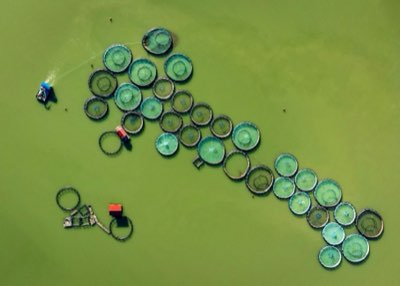
At 5:30 AM, a lone fisherman pulls in a heavy net under a rising sun, his muscles aching from the salt air. In a modern aquaculture facility, however, the "catch" is often managed by automated feeders and digital water quality sensors.
This shift from hunting to farming has fundamentally changed how the world eats.
According to the Chinese Bureau of Fisheries, aquaculture harvests grew at an annual rate of 16.7% between 1980 and 1997.
In 2016, aquaculture accounted for 47% of the total global fish production. When non-food uses are included in the calculation, that percentage rose to 53% in 2016. This transition marks a permanent change in how humanity interacts with aquatic resources.
The sheer volume of modern production is staggering. In 2024, aquaculture reached a record production of 103 million tonnes of aquatic animals. This 2024 output represented 53% of the global aquatic animal output.
The distribution of these species varies significantly depending on the environment. Freshwater systems dominate the market, accounting for 63% of the total volume, which equals 64 million tonnes. Marine and coastal systems contribute the remaining 37%, totaling 38 million tonnes.
As we look at these numbers, we must ask where these massive quantities are actually coming from.
Where is the global seafood supply chain located? Beneath the humid haze of a crowded harbor, a dockworker grips a heavy crate while the scent of brine fills the air.
A shipping container sits on a dock in Singapore, waiting to be loaded onto a vessel bound for Europe or North America. This single container represents a fraction of a global web of production.
The geographic concentration of this industry is intense. In 2024, Asia accounted for approximately 89% of global aquatic animal aquaculture production. This level of concentration means that global food security for seafood is heavily tied to the stability of Asian markets.
The dominance of specific nations is even more pronounced. The top five countries—China, Indonesia, India, Vietnam, and Bangladesh—collectively produced 82% of the total global output. While other regions are growing, the center of gravity remains firmly in the East.
Other regions play much smaller roles in the global volume. Latin America and the Caribbean contribute 3% to the global total, while Europe, Africa, North America, and Oceania each contribute 2% or less.
Specialization is another key factor in the supply chain. For instance, about 75% of farmed shrimp globally originates in Asia, particularly in China and Thailand. The remaining 25% comes primarily from Latin America, with Brazil leading as the largest producer in that segment.
With such a massive global footprint, how does this industry translate into actual wealth for nations?
What is the economic impact beyond the tank? An entrepreneur in a coastal village watches a new hatchery being built, seeing it as more than just tanks; they see it as a path to economic stability. For many, aquaculture is the difference between subsistence and growth.
According to World Bank data, the world recorded GDP growth of 2.9% in 2025.
The sector's role in national economies is diverse and significant. The combined relative GDP contribution of aquaculture and capture fisheries has ranged from 0.01% to 10% depending on the country. In many developing nations, this sector is a primary driver of economic development.
The historical growth of the industry has been explosive. Between 1980 and 1997, the Chinese Bureau of Fisheries reported that aquaculture harvests grew at an annual rate of 16.7%, jumping from 1.9 million tonnes to nearly 23 million tonnes.
This rapid scaling set the stage for the global dominance seen today.
The workforce behind these numbers is also diverse. FAO estimates that in 2016, women accounted for nearly 14 percent of all people directly engaged in the fisheries and aquaculture primary sector. This highlights the essential role of gender diversity in the global maritime workforce.
While the economic potential is vast, the biological reality of domesticating species presents unique hurdles.
The Biological Limits of Domestication
A scientist examines a specimen in a lab, noting the subtle differences between wild and domesticated traits. The ability to farm a species is not guaranteed by its popularity in the market.
The history of biological domestication shows that we are still in the early stages of utilizing marine life. Given the long-term importance of agriculture, to date, only 0.08% of known land plant species and 0.0002% of known land animal species have been domesticated.
In contrast, our success in the water has been higher. Research shows that 0.17% of known marine plant species and 0.13% of known marine animal species have been domesticated. While these percentages seem small, they represent a massive biological undertaking.
The gap between land and sea domestication highlights the difficulty of managing complex aquatic ecosystems. Moving species from the wild to a controlled environment requires precise biological knowledge to prevent collapse.
This biological complexity leads to significant challenges in maintaining the integrity of the global supply chain.
Challenges in Global Distribution and Quality Control
A customs agent in a busy port examines a shipment of frozen fillets, looking for signs of mislabeling or spoilage. In a globalized market, verifying the origin of seafood is a constant battle.
As reported by NOAA, seafood inspectors find fraud in up to 40 percent of products submitted to them voluntarily.
The sheer scale of global trade makes oversight difficult. One of the primary risks in the seafood industry is fraud, where products are mislabeled to increase profit margins.
In the United States, the stakes are high for consumers. NOAA's seafood inspectors see about one-fifth of the seafood consumed in the United States every year and find some kind of fraud in up to 40 percent of all products submitted to them voluntarily.
This statistic underscores the vulnerability of the global distribution network to deceptive practices.
The logistics of moving perishable goods across oceans require perfect timing and cold-chain integrity. A single breakdown in the supply chain can lead to massive economic losses and safety risks.
As the industry grows, how can we balance economic expansion with these systemic risks?
Comparison of Production Systems
| Feature | Freshwater Aquaculture | Marine/Coastal Aquaculture |
|---|---|---|
| Primary Environment | Lakes, rivers, ponds | Oceans, coastal lagoons |
| Global Volume (2024) | 64 million tonnes | 38 million tonnes |
| Percentage of Total | 63% | 37% |
| Key Challenge | Water quality & oxygen | Salinity & tidal management |
Summary of Global Seafood Dynamics
- Shift in Source: The global supply has moved from wild-capture to aquaculture-dominant.
- Regional Power: Asia holds the vast majority of production capacity.
- Economic Impact: The sector provides vital GDP contributions and employment globally.
- Biological Constraints: Domestication remains a fraction of total species availability.
- Integrity Risks: Fraud and logistics are the primary hurdles in global distribution.




Comments 0